Air Source Heat Pump Installation
Full-home air source heat pumps replacing gas or oil boilers — designed to MCS standards, commissioned to MIS 3005 and eligible for the £7,500 BUS grant.
- From
- £10,500 (before £7,500 grant)
- Timeline
- 3–5 days
- Warranty
- 5 years parts & labour
Why choose this
- £7,500 Boiler Upgrade Scheme grant
- COP 3.5–4.5 — 350–450% efficient
- 20-year design life
- Zero on-site emissions
What's included
- MCS heat-loss survey to EN 12831
- 5–16 kW monobloc heat pump
- Cylinder swap (usually 250–300L)
- Radiator upgrades where needed
- System balancing & weather compensation
How air source heat pumps work
An ASHP extracts heat from outside air — even at −10 °C — and upgrades it to 45–55 °C for radiators and hot water. Because it's moving heat rather than generating it, the coefficient of performance (COP) is typically 3.5–4.5, meaning every 1 kWh of electricity delivers 3.5–4.5 kWh of heat. A well-designed system undercuts a gas boiler on running cost even at current electricity prices.
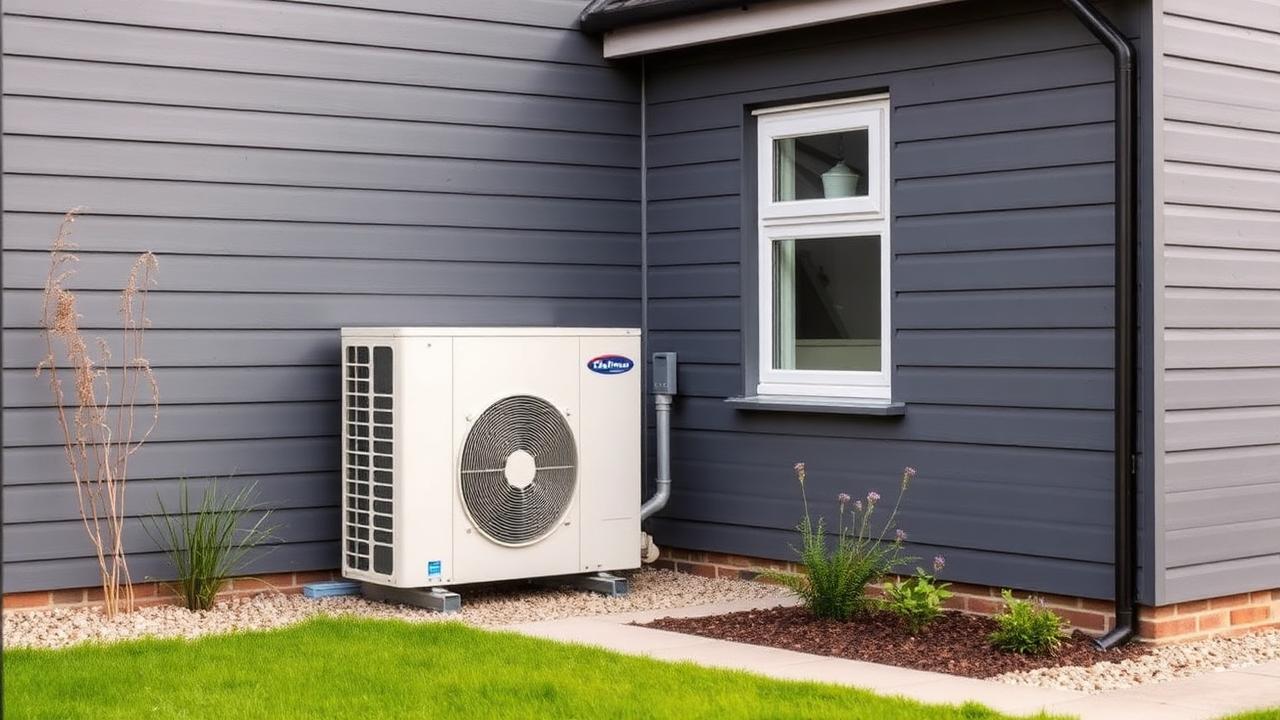
Modern monobloc units contain all the refrigerant in a sealed outdoor cassette. Only water flows into the house — no F-Gas obligation on the homeowner, no risk of refrigerant leaks into occupied space, and a much simpler serviceability model versus split systems.
Design is everything
The single biggest failure mode is undersized radiators. Heat pumps run at 45 °C flow (vs 70 °C for gas) so radiators need roughly double the surface area. Our MCS survey identifies which rooms need upgraded emitters — typically 30–50% of radiators in a 1980s house, less in newer builds.
We use MCS-compliant EN 12831 heat-loss calculation software, room-by-room, to produce a proper design. Anyone quoting for a heat pump without individual room heat-loss figures is guessing — and undersized systems that can't hit setpoint on cold days give the technology a bad reputation it does not deserve.
Grant and paperwork
As MCS-certified installers we handle the Boiler Upgrade Scheme application on your behalf. The £7,500 grant is paid to us and deducted from your invoice; you never handle the money. Building Control notification, DNO notification for the larger units, and EPC updates are all included.
Eligibility requires a valid EPC dated within the last 10 years and no outstanding loft/cavity insulation recommendations. We check the EPC at survey stage — if there are open recommendations we can help you address them (or link to a partner) before submitting the BUS application.
Cylinder and hot water
Almost all heat pump installs need a new cylinder — existing 120 L direct-electric cylinders are too small and lack the coil area needed to accept 45 °C heat pump water at usable flow rates. We specify unvented cylinders of 200–300 L with high-surface-area heat pump coils (2.5–3.5 m² typically).
Cylinder location matters — proximity to the heat pump keeps primary pipe runs short and efficient. A garage, utility room or loft location beats the traditional airing cupboard for both efficiency and future service access. We survey and recommend at design stage.
Noise and permitted development
Permitted development rules allow a heat pump under 42 dB(A) at the neighbour's nearest habitable window, 1 m minimum from any boundary and 0.6 m³ max volume. Modern Mitsubishi Ecodan, Daikin Altherma and Vaillant aroTHERM units all meet the noise limit at typical mounting positions.
We measure at survey with a Class 2 sound meter and confirm compliance in writing before install. If your chosen position fails, we identify alternatives (side wall vs rear wall, ground vs wall bracket) or spec an acoustic enclosure that brings the reading inside the limit.
Running cost and payback
For a typical 4-bed detached house replacing a 15-year-old gas boiler, we see annual heating cost drop from £1,750 (gas) to £1,150 (heat pump on standard tariff) or £780 on a heat-pump-optimised tariff like Octopus Cosy or OVO Heat Pump Plus. Payback on the net capex (post-grant) is typically 6–10 years vs continuing with gas, or immediate vs replacing an oil boiler.
Combined with solar PV and a home battery, marginal running cost drops further — some clients report zero heating cost in shoulder seasons and 60–70% self-sufficiency in mid-winter. We design cross-vector systems (PV + battery + heat pump + smart tariff) as part of our specification service.
Thermal store vs direct hot water strategy
Two main hot-water strategies work with heat pumps: (1) direct heating of a 200–300 L unvented cylinder via a large coil — simplest, cheapest, well-understood, adequate for typical 4-bed use; (2) thermal store or buffer tank — decoupling heat pump run cycles from hot water demand, better for very high hot water use or heat pumps operating with intermittent solar PV.
For most UK homes the direct cylinder approach is the right answer. Thermal stores make sense on larger homes (6+ bedrooms, high concurrent shower demand), homes with solar PV where surplus energy can pre-heat the store, or off-grid sites where minimising heat pump start-stop cycles matters for compressor life.
Weather compensation and control strategies
Weather compensation is the single most important control feature on a heat pump. As outside temperature drops, the flow temperature to radiators is automatically raised — hitting the design flow temperature only on the coldest days. On mild days the flow temperature might be 32 °C instead of 45 °C, dramatically improving COP.
Our commissioning sets the weather compensation curve for your specific house and radiator sizing, then adjusts through the first heating season based on measured comfort feedback. Getting this curve right typically improves seasonal COP by 15–25% versus a poorly-configured system running at fixed high flow temperature.
Common myths debunked
Three heat pump myths we correct on every survey: (1) 'heat pumps don't work in cold weather' — modern units maintain COP 2.5+ at −10 °C and are the primary heating source in Scandinavia; (2) 'you need to replace all your radiators' — typically 30–50% of radiators need upsizing on a 1980s house, less on newer builds; (3) 'they're noisy' — modern monoblocs run at 42–48 dB at 1 m, quieter than a domestic fridge measured at the same distance.
Our design service gives evidence-based answers for your specific home rather than repeating generic marketing claims. We use real heat-loss data, real radiator schedules and real noise measurements taken at your property.
Real-world case study: 1930s semi in Bristol
A four-bedroom 1930s semi in Bristol with solid-brick walls, single-glazed sash windows and a 24 kW gas boiler serving 12 aged Type 21 radiators. Annual gas consumption 24,500 kWh at £1,890 (2024 tariff). Client wanted to move off gas ahead of price volatility and the 2035 phase-out of new gas boilers.
Heat-loss survey (EN 12831) returned design heat loss of 11.2 kW at −3 °C. We specified a Vaillant aroTHERM plus 12 kW monobloc heat pump, a 250 L unvented cylinder with 3.5 m² coil, weather-compensated controls and radiator upgrades on 8 of the 12 emitters (K3 replacements on ground floor lounges and dining room, larger K2 on bedrooms). Total install cost £11,850 before £7,500 BUS grant, net £4,350.
First-year monitored data: 6,850 kWh electricity for heating and hot water, SCOP measured 3.62. Annual heating cost £1,940 on standard variable tariff, dropping to £1,320 on Octopus Cosy off-peak. Household comfort survey: 4.9/5 across all metrics, particularly noted improvement in bedroom warmth overnight.
Frequently asked questions
Will my existing radiators work?+
Sometimes. Our EN 12831 heat-loss survey checks each room; the survey report tells you exactly which rads (if any) need upgrading.
How noisy is it?+
Modern monoblocs run at 42–48 dB at 1 m — quieter than a fridge. Permitted development limits are 42 dB at neighbour boundary.
How long does the install take?+
3–5 working days for a typical 4-bed retrofit including cylinder swap and any radiator upgrades. Simpler swaps can be 2 days.
Do I need underfloor heating?+
No. Correctly sized radiators work perfectly. UFH is a nice-to-have not a must-have.
What happens in a −10 °C cold snap?+
Modern heat pumps maintain COP 2.5–3.0 at −10 °C ambient — still very efficient. We size to meet the design condition (typically −3 to −4 °C for most of the UK) with headroom for extreme events.
Do I lose my gas supply?+
Optional. You can keep gas for the hob and cap the boiler feed. Full decommission removes the gas meter and eliminates the standing charge — worth ~£120/year.
Can I keep my existing hot water cylinder?+
Almost never — existing cylinders lack the coil area for heat pump temperatures. Budget £900–£1,400 for a replacement 250L unvented cylinder including install.
Do I need a special electricity tariff?+
Not required, but heat pump tariffs (Octopus Cosy, EDF GoElectric) typically save 15–25% versus standard variable. We help you choose at handover.
What about heat pump financing and pay-as-you-save?+
Beyond the £7,500 BUS grant, several financing routes exist: manufacturer 0% finance (typically 3-5 years, subject to credit check), green mortgages with preferential rates for heat pump homes, and pay-as-you-save schemes offered by some local authorities where installation is repaid through electricity bill savings over 8-10 years. We help clients navigate these options at survey stage — total cost of ownership over 20 years typically shows heat pump ahead of gas even before grants and financing.
Related services
Home Air Conditioning Installation
Whole-home cooling & heating with quiet inverter splits engineered for UK houses and flats.
Commercial Air Conditioning Installation
Retail, hospitality and mixed-use fit-outs — cassettes, ducted and VRF with BMS integration.
Office Air Conditioning Installation
Discrete cassette and ducted systems that keep meeting rooms cool without wall-mounted eyesores.