Wall Mounted Air Conditioning Installation
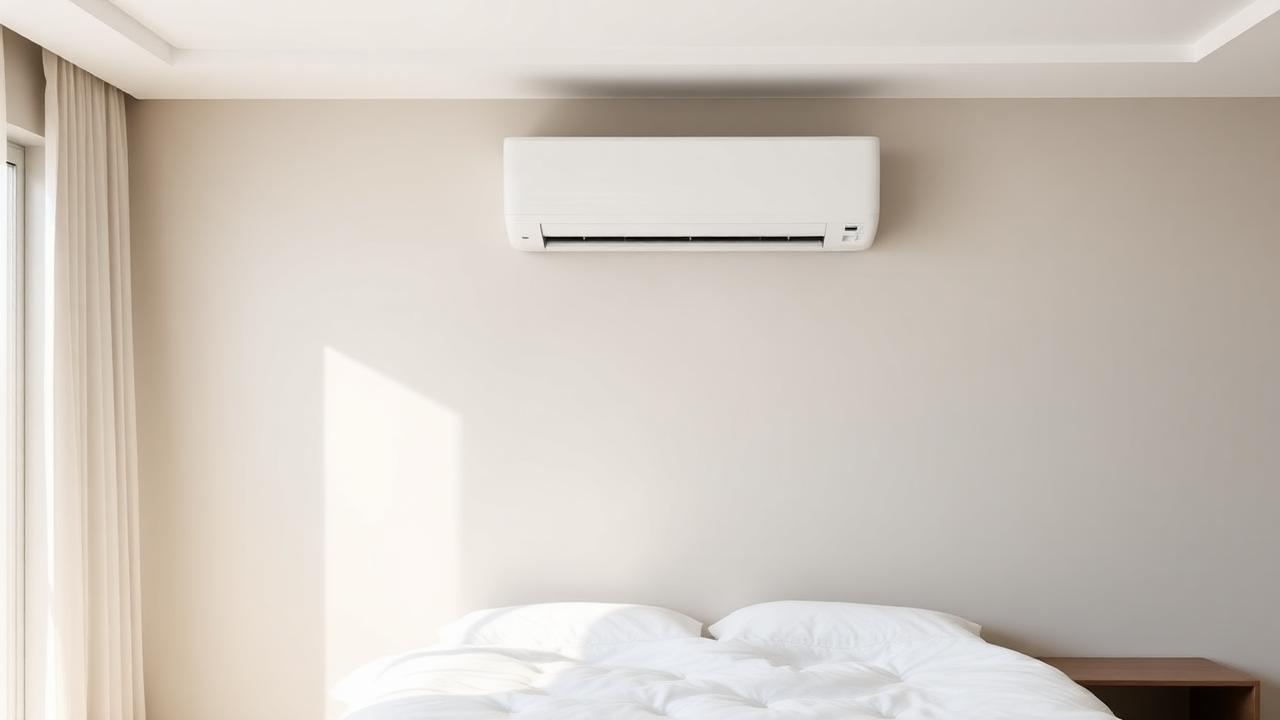
The wall-mounted split is the default choice for UK homes and small offices — slim (180 mm deep), silent (from 19 dB) and the fastest indoor format to install.
- From
- £1,500
- Timeline
- 1 day per unit
- Warranty
- 5 years parts & labour
Why choose this
- From 19 dB — quieter than a whisper
- Slim 180 mm depth — recesses cleanly
- Best top-down cooling airflow pattern
- Widest choice of brands and finishes
What's included
- High-level wall mounting (2.0–2.4 m)
- 65 mm core-drill through external wall
- Concealed or trunked pipework
- Wireless remote + optional WiFi module
Why wall-mounted dominates the UK market
It's the cheapest indoor format, the quickest to install and delivers the best airflow pattern for cooling (cold air blown horizontally then falls). Modern units in white, silver or black finishes blend cleanly with contemporary interiors, and the wall bracket occupies only 900–1100 mm of wall width.
Across UK residential installations wall-mounted accounts for roughly 78% of all indoor units sold — outselling cassettes, floor consoles and ducted combined. The economics are simple: fastest to fit (six to eight labour hours per zone), lowest indoor unit cost, widest brand and finish choice, easiest to service without ceiling access.
Ideal mounting position
We site units at 2.0–2.4 m off floor, at least 150 mm below ceiling for return-air clearance, on a wall adjacent to the room's main occupied zone. Avoiding direct sightlines from beds and sofas is the top comfort priority — the goal is cooled air reaching you before the airflow itself.
Where the ideal wall is not viable (glazing, chimney breast, party wall to a neighbour) we survey alternatives and explain any comfort trade-off before you commit. Corner mounting is possible with brand-specific brackets but slightly reduces coverage on the shorter throw side.
What can go wrong
The three failure modes we see when replacing bad installs are: undersized pipe runs, missing condensate fall, and skipped nitrogen pressure test. All three cause premature compressor failure within 2–4 years. Ask any installer to show you the pressure-test and vacuum readings before signing off.
A fourth we see less often but more expensive to fix: condensate discharged into cavity walls instead of externally. Every winter the pooled water freezes and cracks masonry from inside. Any AC condensate must terminate to an external gully, a saddle-clipped soil stack or a listed condensate pump — never inside a wall cavity, ever.
Airflow patterns and comfort
Wall-mounted units use a 'Coanda effect' fan design — cold air hugs the ceiling then falls gently across the room rather than blasting directly downward. Modern models add motion detection (Mitsubishi 3D i-see, Daikin Intelligent Eye) that redirects louvres away from detected occupants when cooling and towards them when heating.
In heating mode this matters — warm air naturally rises, so pointing louvres downward is essential to avoid stratification where the ceiling reaches 26 °C while the floor stays at 18 °C. All modern wall units auto-manage this via factory-programmed heat-mode louvre angles.
Aesthetics and finishes
The default white body suits most contemporary interiors but is not the only option. Daikin Emura ships in silver or black glass finish. Mitsubishi MSZ-LN offers pearl white, ruby red, natural white and onyx black. LG Artcool Gallery accepts a printed photograph front panel — some clients replace it seasonally with family images or artwork.
For period interiors where any visible unit is unwelcome, we recommend the ducted or floor-mounted alternatives — wall-mounted is not always the answer. Our survey report includes finish samples so you can compare against your paint and fabric palette before ordering.
Long-term durability
Manufacturer accelerated life testing puts a well-installed wall unit at 40,000 hours of compressor life — around 15 years of typical UK usage (2,000–2,500 hours per year mixed cooling and heating). Salt-air coastal locations reduce that to 10–12 years due to fin corrosion; we specify coated coils (Mitsubishi Blue Fin, Daikin Baked Coating) as standard for any install within 10 km of the coast.
The indoor plastic fascia yellows very slowly under UV — install in a lit interior and expect noticeable colour change only after 12+ years. Bracket, drain pan and fan bearing are all serviceable parts; the compressor is not, and its failure typically triggers unit replacement rather than repair.
Pipe routing options for period homes
Victorian, Edwardian and 1930s homes rarely have convenient stud walls or floor voids for hidden pipework. We survey each property individually and typically offer three routing options: (1) surface-mounted decorative trunking in RAL-matched white or brown, running externally along mortar joints — the neatest option for most terraces; (2) chased into external render then plastered flush — invisible but only viable during wider refurbishment; (3) internal hidden routing through cupboards, chimney breasts or wardrobe voids — most complex but zero external visual impact.
Each option is quoted with photo-annotated pipe routes so you can decide before commit. Where the property is listed or in a conservation area we produce heritage impact documentation for planning submission.
Fan speeds, quiet modes and sleep programmes
Modern wall units offer 5–7 fan speeds plus a whisper-quiet 'night mode' that drops indoor unit sound to 19–22 dB while gradually raising setpoint over the night to match falling metabolic heat output. On a hot summer night the unit starts at 20 °C at 22:00 and drifts to 23 °C by 05:00 — matching sleep-cycle temperature preference and cutting energy by 30% versus a fixed setpoint.
Sleep programmes are brand-dependent but every major manufacturer offers a version. Mitsubishi 'Night Mode' and Daikin 'Comfort Sleep' are the most refined; we set them up on your app during commissioning and demonstrate operation before we leave.
Reducing outdoor unit visual impact
The outdoor condenser is often the most contentious part of a wall-mounted install — planning objections and neighbour disputes almost always centre on it rather than the indoor unit. We offer three visual mitigation options: (1) proprietary condenser guards in RAL-matched louvred metal, (2) trellis or planting screens (with airflow clearance maintained), (3) recessed positioning behind rear projections or beside downpipes to disguise from street view.
For tight urban terraces we can also specify low-profile condensers (Mitsubishi 800×550 mm slim range) that fit under kitchen windows or beside back doors without dominating the outdoor space. Our survey report includes 3D photo-mock-ups so you and any neighbours can see the finished look before installation.
Filter types, MERV ratings and indoor air quality
Every wall-mounted unit ships with a pre-filter that catches lint, hair and coarse dust — MERV 4 equivalent, washable, servicable at home. This is not an air-purifier: submicron particles, pollen and viruses pass straight through. For homes where air quality matters (asthma sufferers, urban air pollution, allergy prone occupants) we retrofit compatible higher-grade filters at commissioning.
OEM upgrade filters include HEPA-lite (MERV 13), activated carbon (VOC and odour), photocatalytic (destroys bacterial biofilm on the coil) and ionising (Daikin Streamer, Mitsubishi Plasma Quad). Each is a factory-approved slot-in module — no aftermarket bodging. Filter replacement is typically annual, £15–£45 per unit. The combined effect on measured PM2.5 in a typical London bedroom is a reduction from ambient 12–18 µg/m³ to under 3 µg/m³ within 20 minutes of unit start-up — meaningful for asthma sufferers and quantifiable via consumer air quality monitors.
Frequently asked questions
Can it go above a bed?+
Yes, but we angle louvres away from the sleeping position and often specify a model with a 'motion detect' sensor that redirects airflow.
How high off the floor?+
2.0–2.4 m is optimum. Below 1.8 m and airflow hits people; above 2.5 m and heating performance suffers because warm air stays high.
Do I need to redecorate around the unit?+
Usually not — we cut a 65 mm hole for pipes and either mount directly to the finished wall or seal any imperfect matches with a small trim strip. Full plaster reinstatement is quoted if requested.
What size wall unit for a 4x4 m bedroom?+
2.5 kW is standard. South or west-facing rooms with large glazing may benefit from 3.5 kW to give faster pull-down on hot days.
Can it be recessed into the wall?+
Full recess is uncommon — most homeowners accept the 180 mm proud profile. Bespoke recessing is possible in new-build stud walls (add £400–£600) but not viable in solid masonry.
How easy is it to clean?+
Two pull-out filters accessible from the front — rinse under a tap monthly in summer. Full coil clean during annual service handles anything the filter misses.
Do you supply and install the WiFi controller?+
Yes — configured to your home network during commissioning. We support 2.4 GHz WiFi standards; mesh routers and dual-band networks work fine.
Can the outdoor unit go on a flat roof?+
Yes — with vibration-isolated feet and flashing to preserve waterproofing. We coordinate with roofing contractors where a warranty is at stake.
Related services
Home Air Conditioning Installation
Whole-home cooling & heating with quiet inverter splits engineered for UK houses and flats.
Commercial Air Conditioning Installation
Retail, hospitality and mixed-use fit-outs — cassettes, ducted and VRF with BMS integration.
Office Air Conditioning Installation
Discrete cassette and ducted systems that keep meeting rooms cool without wall-mounted eyesores.