VRF Air Conditioning Installation
Variable Refrigerant Flow is the workhorse of commercial climate control — one modular outdoor unit drives dozens of indoor units, modulating refrigerant flow precisely to match each zone's load.
- From
- £28,000 for 10-zone system
- Timeline
- 3–8 weeks
- Warranty
- 5 years parts & labour
Why choose this
- Up to 64 indoor units per system
- 3-pipe systems recover heat between zones
- Modular condenser (8–96 HP)
- Full BACnet/Modbus BMS integration
What's included
- Daikin VRV, Mitsubishi City Multi or Toshiba SMMS
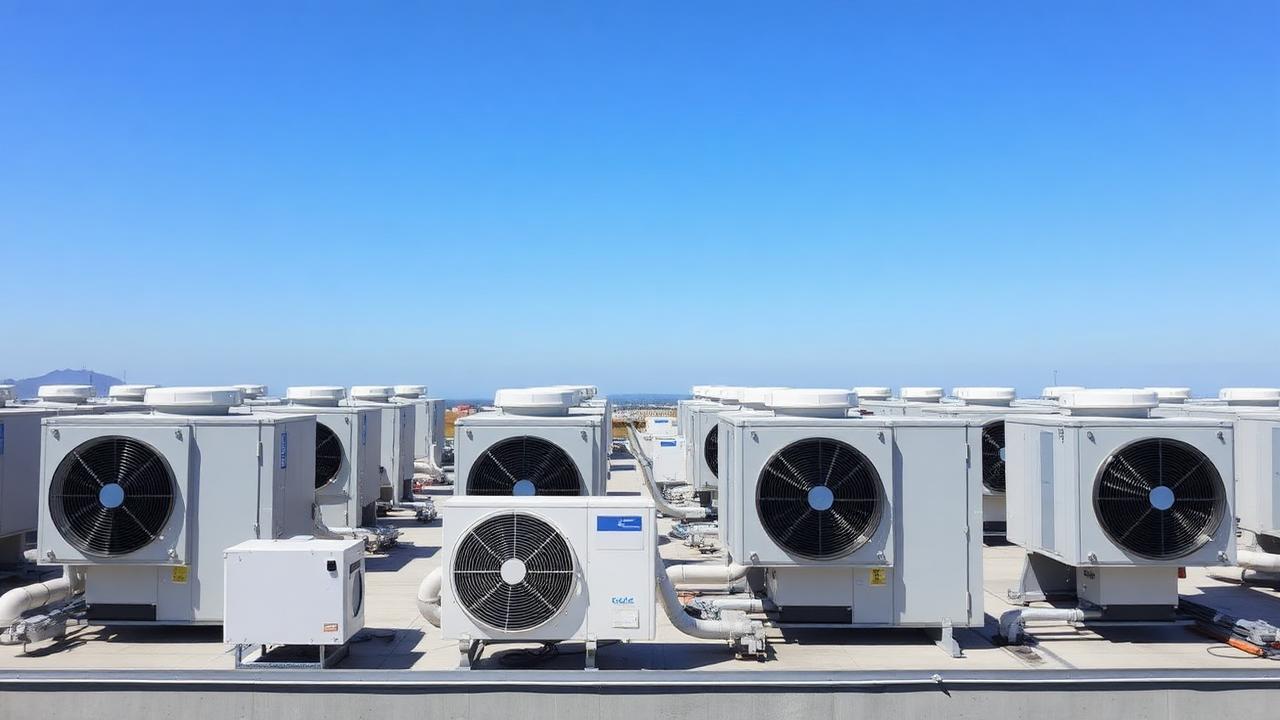
- Roof or plant-deck condenser array
- Refrigerant piping with branch selectors
- Central touch-screen controller
Why VRF for larger buildings
Above ~400 m² or 10 zones, individual splits become uneconomic — you'd need multiple outdoor units, complex wiring and separate controls. VRF consolidates all that into one modular condenser bank on the roof, freeing valuable ground-level space and simplifying facade design.
VRF also wins on part-load efficiency. Because the compressor stepwise modulates from 6% to 100% capacity, the system operates near its efficiency peak far more of the time than any single or multi-split can. Real-world seasonal COP data from Mitsubishi City Multi installations shows 4.2–4.6 average across UK climate zones.
Heat recovery mode
3-pipe heat recovery VRF is where the real magic happens. When your south-facing office needs cooling and your north-facing meeting room needs heating simultaneously, the system moves heat between them — effectively free heating. In mixed-use buildings this cuts total energy consumption by 20–40% versus conventional systems.
The heat-recovery premium adds around 12–18% to VRF equipment cost but typically pays back within three to four years on the reduced running cost. For any building over ~600 m² with mixed exposure, 3-pipe is now the default rather than the upgrade.
Design and commissioning
VRF projects need proper mechanical design — pipe sizing, pressure drops, oil return in long risers, refrigerant charge calculation. We use manufacturer software (Daikin Xpress, MELCADesigner) and provide full CIBSE-compliant drawings for M&E consultant sign-off.
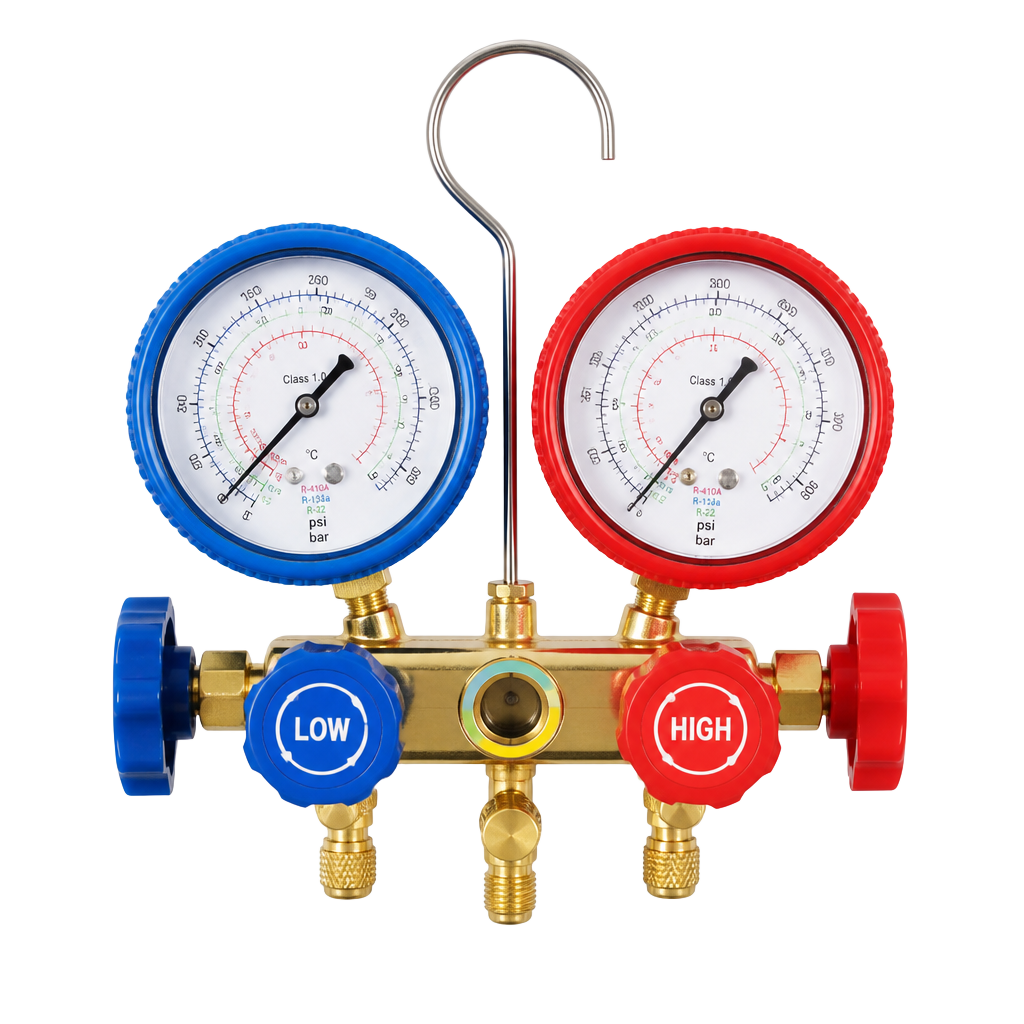
Commissioning is a two-week process on any medium VRF — nitrogen pressure hold at 4.15 MPa for 24 hours, deep vacuum below 200 microns, staged refrigerant charging with real-time superheat/subcool monitoring, and a full BSRIA BG49-format report. We invite the client's M&E consultant on site for the commissioning witness — no black-box handover.
Brand comparison
The UK VRF market is dominated by Daikin VRV, Mitsubishi Electric City Multi, Toshiba SMMS-e and Fujitsu Airstage. Each has strengths — Daikin for the broadest indoor unit range and best software tools, Mitsubishi for reliability and controls integration, Toshiba for compact condenser footprint and Fujitsu for value.
We are accredited to design, install and warrant on all four platforms. Brand selection usually comes down to client preference, existing estate compatibility (if you have five other Daikin sites, we won't push you to Mitsubishi) and any specific technical demands (Mitsubishi Hybrid VRF uses water rather than refrigerant on the tenant-side loop, mandatory for some new residential developments).
Compliance: F-Gas, DSEAR and BS EN 378
VRF systems typically hold 20–100 kg of R-410A or R-32 refrigerant. This puts them well over the 5 tCO₂e threshold requiring statutory F-Gas leak checks every 6 or 12 months depending on charge weight. We hold the company F-Gas certificate and operate as your Responsible Person, keeping records for HMRC and Environment Agency inspection.
BS EN 378 also caps refrigerant concentration in occupied spaces to a defined maximum per m³ of room volume. Small internal rooms served by a large VRF may exceed the limit and trigger the need for refrigerant leak detection. Our design covers this at RIBA Stage 3 rather than finding it out during a commissioning audit.
Operating economics
For a typical 1,500 m² office VRF (installed cost ~£180k), annual electricity is around £11–£15k depending on occupancy pattern. Maintenance under a Gold contract runs £6–£8k per year. Expected life of the outdoor kit is 15–20 years with mid-life PCB refresh at year 10–12.
Compare that with the old fan-coil + boiler alternative: capex is similar but running cost typically 40% higher, and boiler-based systems face imminent gas phase-out. VRF is now the default long-life choice for any commercial building that expects to be occupied beyond 2035.
Sizing the outdoor condenser bank
VRF outdoor units are modular — Daikin VRV, Mitsubishi City Multi and Toshiba SMMS all offer 8, 10, 12, 14, 16, 18 and 20 HP single-module condensers that can be combined into banks of 2 or 3 for higher capacities. A 60 HP system is typically three 20 HP modules on a common refrigerant manifold.
Sizing follows a diversity approach — total connected indoor capacity is typically 100–130% of outdoor nameplate, relying on the reality that not all zones peak simultaneously. On design-day cooling conditions the system runs at 85–95% of nameplate; part-load efficiency is where VRF earns its running-cost premium over conventional plant.
Refrigerant leak detection systems
BS EN 378 requires refrigerant leak detection in any occupied space where an accidental leak could exceed the practical safety limit for the refrigerant used. For R-32 VRF systems this generally means every internal room served by the system needs a permanently-installed leak sensor with alarm output to the BMS.
We design leak detection into every VRF project as standard — sensor per room, addressed onto a Modbus network, integrated with the BMS to trigger both audible alarm and automatic refrigerant pump-down on detection. Full compliance documentation is provided with the O&M pack for future statutory inspections.
Commissioning: the make-or-break phase
VRF systems are unforgiving of poor commissioning. Refrigerant charge accuracy to within 2% of design, superheat calibration on every indoor EEV, oil balance across parallel compressors, and full 24-hour pressure hold at 4.15 MPa before any refrigerant is admitted — miss any one and the system will suffer either efficiency loss or premature failure within 2 years.
Our commissioning process is documented against a 60-point checklist derived from BSRIA BG 49. Every parameter is captured with photographic evidence in the commissioning report. The client (or their M&E consultant) is invited to witness the pressure test and final commissioning walk-through — no black box, no hidden shortcuts.
Choosing between 2-pipe, 3-pipe and Hybrid VRF
Three main VRF architectures serve different applications. 2-pipe systems (heat pump only) allow every indoor unit to cool or heat but not both simultaneously — appropriate for offices and retail where thermal loads are directionally uniform. 3-pipe systems (heat recovery) allow simultaneous heating and cooling across different zones — essential for mixed-use buildings and any facade with strong solar-gain differences between sides.
Hybrid VRF (Mitsubishi HVRF, Daikin VRV Air-to-Water) uses water rather than refrigerant on the indoor-side loop, eliminating leak-detection obligations and enabling connection to any hydronic terminal (radiators, fan coil units, underfloor heating, chilled beams). This is now the default choice for residential-above-commercial mixed-use schemes where refrigerant safety concentration limits would otherwise force compromise. We design across all three architectures — the right answer depends on load pattern, refrigerant safety constraints and future flexibility requirements. Our RIBA Stage 3 design workshop produces the comparison in tabular form so the client and consultant can decide against measurable criteria.
Frequently asked questions
How reliable are VRF systems?+
Very — a well-designed VRF system runs 15–20 years. The modular condensers mean partial failure doesn't shut the building down.
What's the F-Gas obligation?+
VRF systems typically hold 20–100 kg of R-410A or R-32 — well over the 5 tCO₂e threshold requiring statutory leak checks every 6–12 months.
Can I add zones after commissioning?+
Yes — provided the outdoor unit was sized with headroom, additional indoor units can be added as long as the total connected capacity stays under 130% of outdoor rated.
What about R-454B or lower-GWP refrigerants?+
R-32 has now replaced R-410A on almost all new VRF ranges. R-454B is emerging but not yet mainstream. All our current specifications use R-32.
Do you offer a design-only service?+
Yes — we produce full VRF designs on a fee basis for M&E consultants and main contractors, either as concept or full working drawings.
How disruptive is retrofit VRF?+
Moderate — outdoor unit placement often requires crane hire, refrigerant piping needs routed service risers or exterior boxing, and grille positions need coordinated ceiling access. 6–12 week programmes are typical for existing occupied buildings.
What's the minimum project size that makes sense as VRF?+
Typically 10 zones or 400 m² total. Below that, multi-splits or several single splits are usually more economical.
Do you offer VRF training for tenant FM teams?+
Yes — a 2-hour hands-on session covering controller operation, alarm response and fault escalation. Included at handover on all commercial VRF projects.
How do refrigerant costs affect long-term ownership?+
Refrigerant top-up on a leaking VRF can be substantial — R-410A now trades at £180-£240 per kg wholesale, and a 60 HP system holds 45-60 kg. A single major leak repair with full recharge can be £8,000-£12,000. This is why leak-tight installation and annual leak checks are critical rather than optional. Our leak detection design and annual F-Gas service programme have kept our maintained VRF estate at under 0.3% annual refrigerant loss versus the industry average of 4-8%.
Can VRF work with district heat networks?+
Yes — Hybrid VRF connects directly to any low-temperature hot water source including district heat networks, communal heat pump plant and geothermal boreholes. This eliminates the outdoor condenser bank entirely for indoor cooling and hot water functions, radically simplifying facade design and enabling much higher building density in urban regeneration schemes. We have delivered several central London mixed-use schemes on this basis.
Related services
Home Air Conditioning Installation
Whole-home cooling & heating with quiet inverter splits engineered for UK houses and flats.
Commercial Air Conditioning Installation
Retail, hospitality and mixed-use fit-outs — cassettes, ducted and VRF with BMS integration.
Office Air Conditioning Installation
Discrete cassette and ducted systems that keep meeting rooms cool without wall-mounted eyesores.